Why “Why Did You Cancel?” Is the Wrong First Question
Learn how a 13-step churn interview framework reveals the real causes of customer loss.

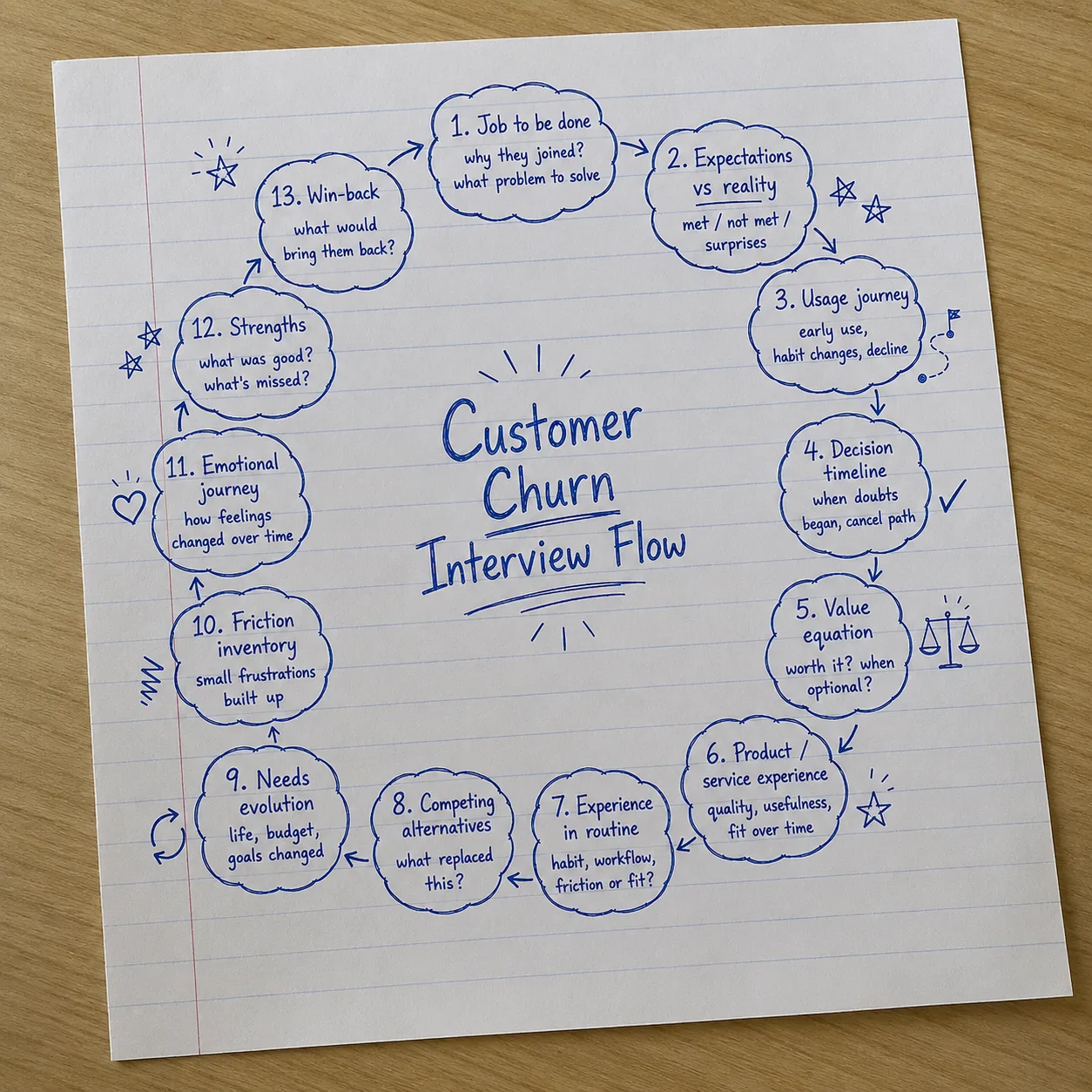
Most churn interviews fail because they begin at the end.
They start with:
“Why did you cancel?”
The answers are usually familiar:
- Too expensive
- Didn’t use it enough
- Found something better
- Life got busy
These answers may be true. But they rarely explain what a company should do differently.
“Too expensive” does not explain why the product once felt worth paying for.
“Didn’t use it enough” does not explain when usage declined or what caused it.
“Found something better” does not explain which need the alternative met more effectively.
The useful insight sits underneath the cancellation reason.
Churn is a Journey, Not an Event
Customers rarely decide to cancel overnight.
They sign up with a goal in mind. They form expectations. They begin using the product. Some expectations are met; others are not. Their routine changes. Frustrations accumulate. Usage declines. An alternative becomes more attractive.
Eventually, cancellation feels like the logical next step.
A good churn interview reconstructs that journey:
- What originally prompted the customer to sign up?
- What did they expect to happen?
- When did reality begin to diverge from those expectations?
- How did their behavior change?
- What frustrations accumulated?
- What alternative eventually won?
- When was the customer still saveable?
The objective is to understand how someone moved from:
“This is worth paying for.”
to:
“I no longer need this.”
That transition is where the retention opportunities live.
The 13-Part Churn Interview Flow
At SignalRise, we structure churn interviews around 13 areas:
-
Job to be done: Why did the customer sign up, and what were they hoping to achieve?
-
Expectations versus reality: Which expectations were met, missed or exceeded?
-
Usage journey: How did engagement change over time?
-
Decision timeline: When did the customer first begin considering cancellation?
-
Value equation: When did the product stop feeling worth the price?
-
Product or service experience: What worked well, and what disappointed them?
-
Fit within the customer’s routine: Did the product fit naturally into their life or workflow?
-
Competing alternatives: What did they choose instead, and why?
-
Evolving needs: Did their goals, circumstances or priorities change?
-
Friction inventory: Which small frustrations accumulated over time?
-
Emotional journey: How did their feelings toward the product change?
-
Strengths: What did they still value or appreciate?
-
Win-back conditions: What, if anything, would make them return?
Look for the Last Saveable Moment
The goal is not to collect complaints.
It is to identify the sequence of events that led to churn, and the moments when a different intervention might have changed the outcome.
The customer may still have been saveable:
- When usage first declined
- When their routine changed
- When a frustration became repetitive
- When they began comparing alternatives
- When perceived value fell below the price
- When they disengaged emotionally but had not yet cancelled
“Why did you cancel?” can still be a useful question.
It just should not be the first (or only) one.
The cancellation reason tells you how the story ended.
The full decision journey shows you where the ending might have been changed.

Retain customers and protect your revenue.
SignalRise runs AI-guided interviews with lost, lapsed, and at-risk customers and turns them into high-impact actions.